ArtsATL
By Jordan Owen
April 10, 2026
original link
A sublime, adventurous program shows the ASO at its best
From Glass to Rachmaninoff to a new work inspired by a traditional Korean folktale, the evening demonstrated the importance of diverse programming.
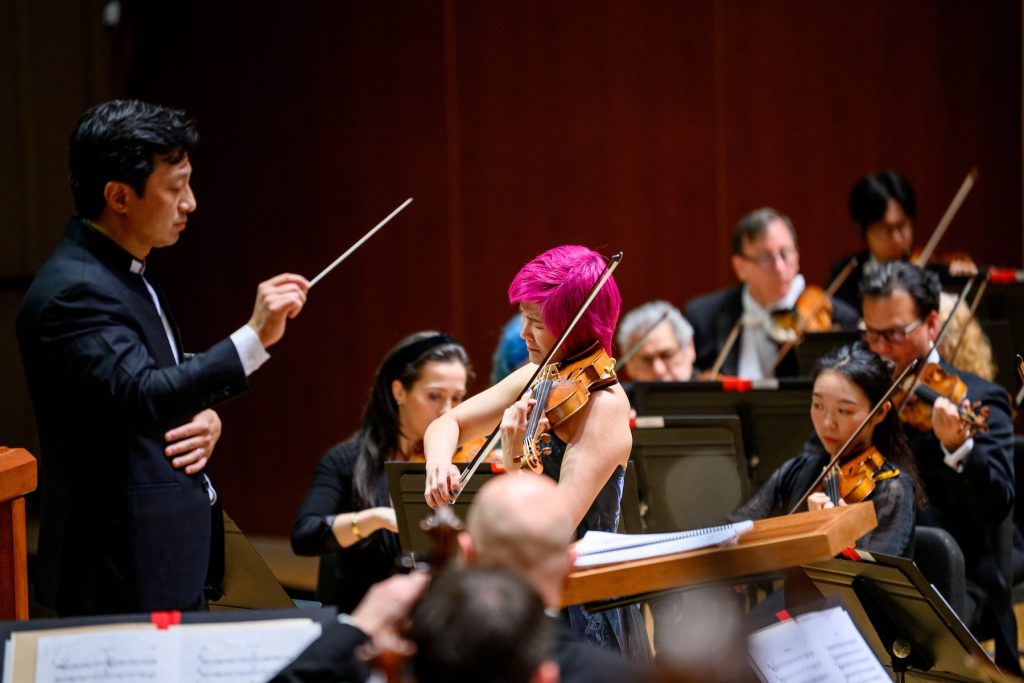 Violinist Jennifer Koh was the featured soloist for Philip Glass’ Violin Concerto No. 1. (Photo by Julian Alexander)
The Atlanta Symphony Orchestra convened Thursday, April 9, for a program that, were such set lists not planned out long in advance, could have been interpreted as a response to my last symphony review. I’d gone hard against the soporific monotony of an evening that saw the ASO limping through Bach’s Mass in B Minor with an uncharacteristic lack of enthusiasm. My read on the whole situation had been that the symphony’s recent Beethoven Project had left it leaning so heavily on well-known classical material that it had become complacent.
I’m pleased to report that, based on Thursday’s performance, my concerns may have been premature. Indeed, if the evening’s concert is any indication, the ASO bandwagon has been lifted from the ditch, thoroughly wiped down and given a fresh coat of paint and varnish before being set back on its usual path. The night saw the world premiere of Nicky Sohn’s A Tale of the Bunny and the Turtle alongside Philip Glass’ Concerto No. 1 for Violin and Orchestra and Sergei Rachmaninoff’s Symphony No. 1 in D Minor. All three were sublime, and each seemed to address my previous criticisms in its own way.
Sohn was on hand to introduce A Tale of the Bunny and the Turtle, her new work inspired by a traditional Korean folktale. Sohn wore a bright pink dress that popped against the tuxedos and black dresses of the orchestra and that served as an apt visual metaphor for what was to come.
There’s a fascinating, creative realm that opens when East Asian composers get their hands on Western musical styles. The Japanese band Sigh is known for blending extreme heavy metal with avant-garde jazz. Hiromitsu Agatsuma plays worldbeat smooth jazz on the shamisen. And K-pop boy bands like BTS stitch hip-hop beats and synthpop into atypical song structures. Such composers don’t perceive the stylistic and cultural barriers that are naturally apparent to their Western counterparts, and the results often open up exciting new sonic avenues.
Sohn’s writing fits comfortably in that realm. The opening passages of Tale have a distinctly Eastern imperial tone — the sort of bold, majestic imposition that fills the occidental imagination with grand visions of paper lantern parades and golden dragons encircling the columns of ominous fortresses. But that initial premise transitions into a sort of cartoonish whimsy — like a madcap George Gershwin throwing caution to the wind. And what’s so engaging about it all is how naturally one flows into the other without sounding like the overall atmosphere has fully shifted. The bold and militaristic shares space with the zany and the lighthearted, and somehow the effect of both atmospheres never fully abates. It’s a sonic hybridization that enthralls and challenges the listener in equal measure.
The performance of Glass’ Concerto No. 1 for Violin and Orchestra featured guest violinist Jennifer Koh. Of the three works on hand, it was the one that I was most curious to see the ASO tackle. Glass is a wildly mixed bag and an acquired taste even among his most ardent fans (myself included). At his best, those endlessly cyclical walls of arpeggios form a lush, hypnotic backdrop for the ambient surrealism of Koyaanisqatsi, the maudlin late middle-age angst of The Hours and the reactionary mania of Mishima: A Life in Four Chapters. At his worst … well, there’s the Philip Glass knock-knock joke: “Knock knock! Who’s there? Knock knock! Who’s there? Knock knock! Who’s there? Knock knock …”
That divisive nature makes Glass a hard sell for a lot of established orchestras. Smaller chamber ensembles love his work (the Kronos Quartet’s recordings through the years are a prime example), and solo pianists have devoured his oeuvre, but full orchestras — which thrive on the multilayered complexity of classical composition — haven’t always shared that enthusiasm. As such, the Glass concerto felt like the evening’s make-or-break moment.
To my pleasant surprise, the whole concerto came together nicely. Koh (whose hot-pink hair continued the evening’s trend of bold fashion choices) understood that the real efficacy of a large-scale Glass composition hinges on the featured instrumentalist’s willingness to embellish the dynamism of the phrases at hand. The melody lines in Concerto No. 1 are sparse and seldom more than arpeggios or overtone sequences that serve to accentuate the underlying chord structure. The real emotion comes in the give-and-take with which such phrases are played, and Koh was keenly aware of that process. The same cycle of notes, though played ad nauseam, has a narrative quality all its own when the player leans in and out of intensity in their delivery.
Koh’s ability to capture that core essence of the large-scale Glass work seemed to carry across the orchestra as a whole. The ASO was more than willing to commit to the bit, and it was refreshing to see the old guard of the Atlanta classical scene leaning into the sort of avant-garde realms that are normally the province of hipster music students.
Rachmaninoff’s Symphony No. 1 in D Minor, Op.13 was a rousing and ethereal closer. Guest conductor Jerry Hou was notably conservative in his performance with a sort of restrained, by-the-numbers approach that nevertheless pulled something intimidating out of the orchestra. Far from the moribund display I’d seen previously, this was an ensemble that was more than willing to awaken the long-dormant leviathan at its core with moments of unabashed fury that startled in their ferocity.
It might be presumptuous to think that my writing held enough sway with the ASO to alter its creative direction, but I left feeling that my core premise had been validated. This was the ASO at its finest: by turns innovative, avant-garde and celebratory of the classics, with no one direction compromising the efficacy of the others. Perhaps it’s just a testament to the importance of diverse programming. Either way, the ASO felt alive once more.
Copyright ©2026 ArtsATL
© Jennifer Koh, All Rights Reserved. Photography by Juergen Frank. Site by ycArt design studio